
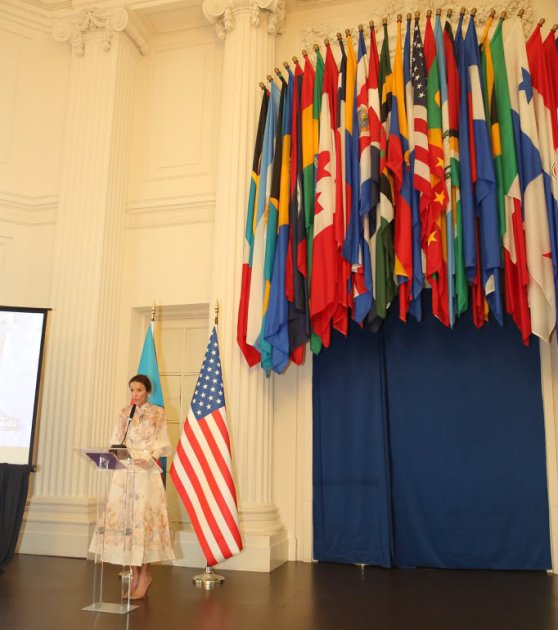
An exhibition-concert program "Oil and Icon" celebrating the 35th anniversary of the restoration of Azerbaijan's independence was organized in Washington, the U.S.
The event, held at the headquarters of the Organization of American States (OAS) with the joint organization of the Azerbaijani Embassy in the U.S. and the Azerbaijan National Carpet Museum, supported by the Ministry of Culture, was attended by US officials, representatives of the diplomatic corps, as well as culture and art figures.
In his opening remarks, Khazar Ibrahim, Azerbaijani Ambassador to the U.S., Azerbaijan's Permanent Observer to OAS, highlighted the historical significance of the 35th anniversary of the restoration of Azerbaijan's state independence.
“Today, we are celebrating the 35th anniversary of the restoration of Azerbaijan's independence. It is very significant that in Azerbaijan, we call it the restoration of independence. We are the only former Soviet republic that actually made this declaration in this way because of our historical heritage. We believe that the republic we established back in 1918, the first democratic republic in the entire Muslim world, is part of our heritage. What we inherited from that republic, we preserve, cherish, and continue,” he said.
“In a couple of days, I will be traveling to Oil City, Pennsylvania, with which we have established sister-city relations. Through these relations, we have shown American audiences that the history of oil, what we call “black gold,” has deep roots in Azerbaijan,” the ambassador mentioned.
“During our first republic in 1918, our forefathers used oil revenues to send the best and brightest Azerbaijanis to leading universities in Europe. Later, during the Soviet period, our National Leader Heydar Aliyev continued this tradition by sending talented young Azerbaijanis to leading educational institutions. Today, under the leadership of President Ilham Aliyev, we have a state scholarship program that provides full financial support to Azerbaijani students admitted to some of the world's top universities. The decree establishing this program begins with the objective of converting “black gold into human capital and this is extremely important to us,” the diplomat added.
The diplomat noted that Azerbaijan is not only sending its brightest students around the world but is also offering scholarships to citizens of every OAS member state to come and study in Azerbaijan.
“Our relations with the United States are currently at their highest level, with a formal strategic partnership. We have cultural exchanges, educational exchanges, and we are building stronger bonds between our peoples,” the ambassador emphasized.
Speaking at the event, Ana Irene Delgado, Panama’s Ambassador to the OAS, described art and music as key drivers of cultural diplomacy in building mutual understanding between peoples.
Addressing the event, Amina Malikova, Director of the Azerbaijan National Carpet Museum, said: “For us in Azerbaijan a carpet is not merely a piece of decorative and applied art. It is not simply a beautiful object that we place in our interiors. It represents the philosophy of the Azerbaijani people. Like every traditional art form, it preserves the wisdom accumulated by our people over centuries.”
“Tonight, we are very happy to present our carpet art. I believe this is the first time that we have created a relief carpet featuring Marilyn Monroe, an iconic figure of world culture, to commemorate her 100th anniversary,” she noted.
Paul Taylor, Research Anthropologist at the Smithsonian National Museum of Natural History, highlighted Azerbaijan’s remarkably rich history connected with folklore, culture, and cultural heritage.
“We are also presenting copies of a book that I prepared with my friends and colleagues, addressing a different aspect of the relationship between art, culture, and heritage. The book is titled Past and Future Heritage in the Pipelines Corridor: Azerbaijan, Georgia, Türkiye. It examines the cultural heritage discovered along the routes of the Baku–Tbilisi–Ceyhan oil pipeline and the South Caucasus natural gas pipeline, which extend from the Caspian Sea through Azerbaijan and Georgia to Türkiye,” he noted.
The event also featured the presentation of Amina Malikova's book, Happiness in Carpets: 10 Reasons Why a Carpet Can Make You Happy, the Smithsonian Institution's publication, Past and Future Heritage in the Pipelines Corridor: Azerbaijan, Georgia, Türkiye, and the project titled Art Therapy: Safeguarding Culture and Health, curated by Lala Sardarli.
Following the official part, a concert program was performed by Honored Artist of Azerbaijan, pianist Nargiz Aliyarova, featuring works by Gara Garayev, Fikrat Amirov, Faig Sujaddinov, and Frédéric Chopin, alongside a piano arrangement of the Azerbaijani folk song "Sari Gelin (Yellow Bride)."
Views: 100